1kW Solar System Philippines: Price, Output, Who It Fits
TL;DR
A 1kW grid-tied solar system costs roughly ₱70,000-110,000 installed in the Philippines, needs about 2 panels and 7-9 sqm of roof, and produces around 120 kWh a month. It suits very small households with bills under about ₱2,000, or anyone starting small with a view to expanding later.
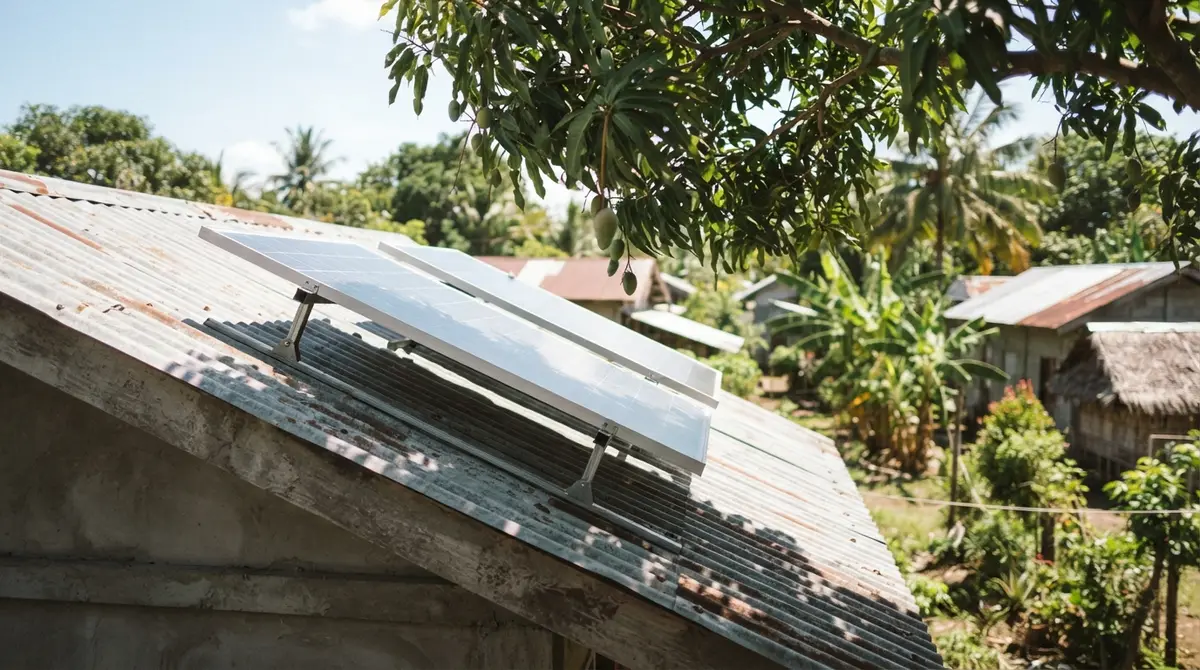
A 1kW grid-tied solar system costs roughly ₱70,000-110,000 installed in the Philippines and produces about 120 kWh a month. It needs around 2 panels and 7-9 sqm of unshaded roof.
This is the smallest system most installers will quote as a proper grid-tied install with permits and net metering. It suits genuinely small households, and it suits people who want to start somewhere and grow — provided the build is planned for that from the beginning.
What you get for the money
| 1kW system | |
|---|---|
| Installed price | ₱70,000-110,000 |
| Panels needed | ~2 (at 500-550W each) |
| Roof space | 7-9 sqm |
| Monthly output | ~120 kWh |
| Suits a bill of | Up to roughly ₱2,000 |
| Typical payback | 5-7 years |
The price per kW is the highest of any size, and that is worth understanding rather than resenting. Permits, net metering paperwork, scaffolding, labour, the inverter, and the electrician’s day cost roughly the same whether they are installing 1kW or 5kW. Those fixed costs spread over one kilowatt instead of five. Our cost breakdown shows what is actually in the quote.
What will it actually run?
About 120 kWh a month, which at Meralco’s 2026 rate of roughly ₱14-15/kWh is around ₱1,700-1,800 of electricity. In appliance terms that comfortably covers:
- A refrigerator running continuously
- LED lighting throughout a small home
- Two or three electric fans
- A TV, router, phone charging, and small electronics
What it will not do is offset aircon. A single 1.0 HP inverter unit run for a few hours a night can consume more than this entire system generates. If aircon is a meaningful part of your bill, you are looking at the wrong size — see solar panels for aircon for what that actually requires.
Who should buy 1kW, and who should not
It fits a small household with a bill genuinely under about ₱2,000 a month, a provincial home running lights, fans and a ref, or a small sari-sari store.
It does not fit anyone hoping to cut a ₱5,000 bill meaningfully. Under net metering, power you export is credited at roughly ₱5-7/kWh while power you buy costs about ₱14-15/kWh. The economics reward sizing to your actual daytime consumption rather than undershooting it badly, and a 1kW array against a large bill leaves most of that bill untouched.
Run your own number through what size solar system for my bill before committing. If it points you at 2kW or 3kW, the cost per kW drops sharply and the payback usually improves.
Starting small on purpose
There is a legitimate case for 1kW as a first step: you want to see real numbers on your own roof before spending more, or your budget genuinely stops there this year.
If that is the plan, say so explicitly when you get quotes, and ask for:
- An inverter sized for the array you eventually want, not the one you are buying now. This is the single decision that makes expansion cheap or expensive.
- Mounting rails with room to extend, so the second batch of panels does not need a fresh structural job.
- Confirmation that the net metering application covers the eventual size, since amending it later means going through the process again.
Get those three right and expanding is largely a matter of adding panels. Get them wrong and the second phase costs nearly as much as starting over, which defeats the point of phasing in the first place.
Is the payback any good?
Typically 5-7 years, somewhat longer than larger systems, for the same fixed-cost reason. The panels themselves are warranted around 25 years, so even at the slow end the system spends most of its life in profit.
The more useful comparison is against the alternative sizes rather than against nothing. If your consumption supports it, a 3kW system usually pays back faster per peso spent. If it genuinely does not, 1kW is a reasonable and honest place to start. Our payback guide walks through the arithmetic on either.
Frequently asked questions
How much does a 1kW solar system cost in the Philippines?
Roughly ₱70,000-110,000 installed as of 2026. Cost per kW is higher than on larger systems because permits, labour, mounting, and the inverter cost broadly the same whether you install 1kW or 5kW, so the fixed costs spread over less capacity.
How much power does a 1kW system produce?
About 120 kWh a month in typical Philippine conditions, based on roughly 4.7 peak sun-hours a day and normal real-world losses. That is around 4 kWh on an average day, more in summer and less through the rainy season.
How many panels is 1kW?
Two panels with modern 500-550W modules, or three with older 350-400W ones. That needs roughly 7-9 sqm of unshaded roof, which is small enough that most homes can find space.
What can a 1kW system run?
About 120 kWh a month covers lights, fans, a router, a TV, and a refrigerator with a little left over. It will not meaningfully offset aircon, which alone can use more than the entire system generates.
Is 1kW worth installing, or should I size up?
It is worth it if your bill is genuinely small, under roughly ₱2,000 a month, since a system much larger than your consumption exports surplus at the lower net metering credit rate. If your bill is ₱4,000 or more, a 2-3kW system almost always gives better value per peso.
Can I expand a 1kW system later?
Yes, if it is planned for. Tell the installer at the start so the inverter and mounting are sized with headroom. Expanding an array whose inverter is already at capacity means replacing the inverter, which erases much of the saving from starting small.