Half-Cut Solar Cells: What They Are and Why They Help
TL;DR
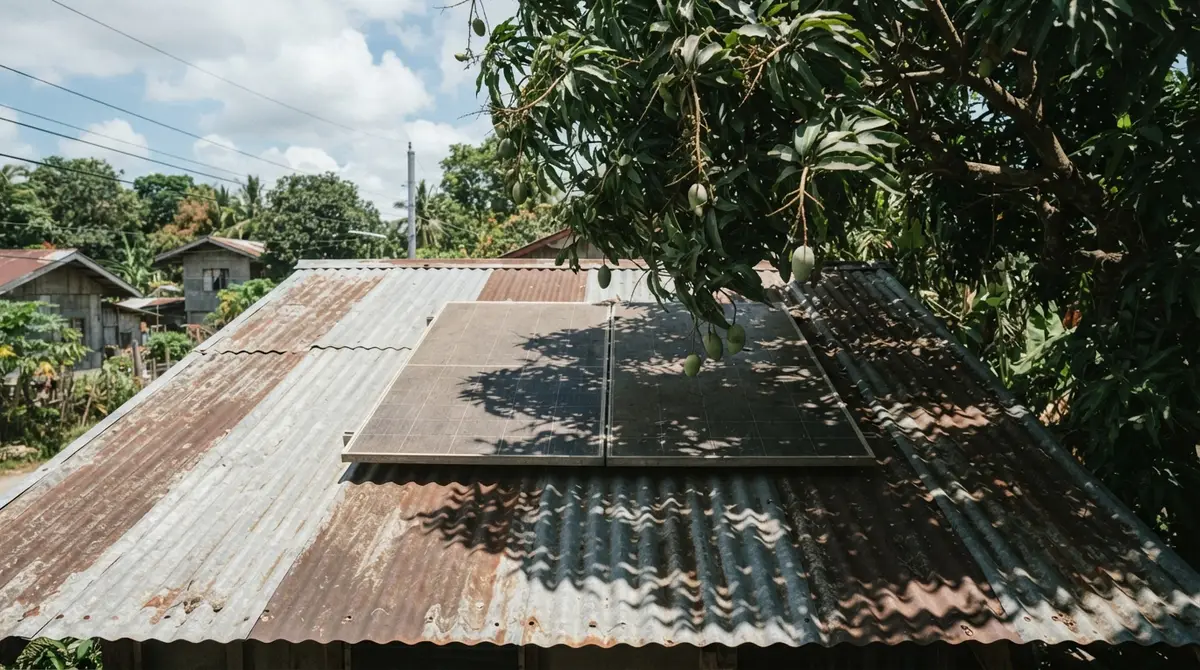
Half-cut cell panels split each cell in two, halving the current through each and cutting resistive losses. They are also wired as two independent halves, so shade on one part of the panel only takes out half of it rather than the whole thing. On cluttered Philippine roofs that shade tolerance is the more useful benefit.
Half-cut cell panels do exactly what the name says: each cell is cut in half, doubling the number of cells while halving the current flowing through each one.
That single change buys two things — lower resistive losses and much better behaviour under partial shade. On Philippine roofs, the second one usually matters more.
Why halving the current helps
Resistive loss in a conductor rises with the square of the current. Halve the current and you cut that loss to roughly a quarter.
In a panel, that shows up as slightly higher output and slightly lower operating temperature, since less energy is wasted as heat. The gain is real but modest — a few percent over an otherwise identical full-cell panel, not a transformation. Anyone selling half-cut construction as a dramatic upgrade is overstating it.
The shade benefit is the interesting one
A half-cut panel is wired as two independent halves, each with its own bypass arrangement.
Practically: if shade falls across the bottom row of cells — from a parapet, a water tank, a vent, a neighbour’s wall in the afternoon — the shaded half drops out while the other half keeps producing. On a conventional full-cell panel, the same shade can compromise the entire panel.
This matters here because Philippine roofs are rarely clean rectangles. They have water tanks, vents, aircon condensers, antennas, and neighbouring structures close by. Partial shading from something small and unavoidable is common, and our shading guide explains why one shaded panel can otherwise drag down an entire string.
Half-cut construction limits the blast radius. It does not remove it.
What it does not fix
Worth being clear, because this gets oversold:
- Shade still costs output. Half a panel producing nothing is still half a panel producing nothing.
- String effects still apply. On a string inverter, a compromised panel still affects its string. If shading is severe or persistent, the real answers are relocating the array or using microinverters or optimisers.
- It is not a substitute for a good layout. Designing the array to avoid the shade in the first place beats mitigating it.
Do you need to ask for it?
Mostly not. Half-cut construction has become standard on most quality panels rather than a premium option, so it rarely appears as a separate line item or cost.
If you are comparing two otherwise equal panels and one is half-cut, take that one. If an installer is charging a meaningful premium specifically for half-cut construction, that is worth questioning — it is a normal feature now, not an upgrade.
What genuinely differentiates panels at the point of purchase is covered in tier 1 vs tier 2 panels, N-type vs P-type, and warranties explained. Cell layout is further down the list than any of those.
Where it fits in your decision
The order that actually determines how well your system performs:
- Sizing to your real consumption — what size solar system for my bill
- Shading and orientation — which direction should panels face
- Installer quality — how to choose an installer
- Brand and warranty
- Cell construction details like this one
Useful to understand when reading a datasheet. Not something to build a purchasing decision around.
Frequently asked questions
What are half-cut solar cells?
Exactly what the name suggests — each cell is cut in half, doubling the cell count while halving the current through each one. Because resistive loss rises with the square of current, halving it cuts that loss substantially.
Do half-cut panels produce more power?
Modestly more than an otherwise identical full-cell panel, through lower resistive losses and slightly better heat behaviour. The gain is real but not dramatic — a few percent, not a transformation.
How do they handle shade better?
A half-cut panel is wired as two independent halves. Shade across the bottom row takes out that half while the other half keeps producing. On a full-cell panel the same shade can compromise the entire panel.
Does that mean shading no longer matters?
No. It limits the damage rather than eliminating it, and on a string system a compromised panel still affects its string. Half-cut construction is a mitigation, not a solution — avoiding shade is still far better.
Are half-cut panels more expensive?
The construction is now standard on most quality panels rather than a premium option, so it rarely appears as a separate cost. If two panels are otherwise equal and one is half-cut, take the half-cut one.
Are they less reliable with twice as many cells?
There is no evidence of that in practice. More cells means more interconnections, but the construction has been mainstream for years and warranty terms are comparable to full-cell panels.