Solar Panel Wattage Guide: 450W vs 550W vs 600W (Philippines)
TL;DR
Panel wattage decides how many panels make up your system, not how much power the system produces. A 5kW array is 5kW whether it is ten 500W panels or nine 550W ones. Higher wattage mainly buys you fewer panels and less roof space, which matters most when roof area is tight.
Panel wattage decides how many panels make up your system, not how much power the system produces. This is the single most misunderstood spec in a solar quote, and getting it straight saves a lot of pointless comparison.
A 5kW array is 5kW. Whether that is ten 500W panels or nine 550W ones, it generates about the same 720 kWh a month in Philippine conditions. The wattage on the datasheet changes the panel count and the roof space, not the output.
What each wattage actually means for your build
Taking a 5kW system as the reference point:
| Panel wattage | Panels for ~5kW | Approx. roof space |
|---|---|---|
| 400W | 13 | ~30 sqm |
| 450W | 11 | ~29 sqm |
| 550W | 9 | ~28 sqm |
| 600W | 8 | ~28 sqm |
Notice how little the roof space column moves. That is the part most people miss: much of the wattage increase over the past decade came from making panels physically larger, not from extracting dramatically more power per square metre. Eight 600W panels take up nearly as much roof as thirteen 400W ones.
So what does higher wattage genuinely buy?
Fewer things to mount and wire. Eight panels instead of thirteen means fewer mounting points, fewer connections, and a slightly quicker install. Every connector is a potential future fault, so fewer is mildly better.
Simpler layout on an awkward roof. Fewer, larger rectangles are sometimes easier to arrange on a clean roof plane.
A tidier array, which matters to some people and not to others.
What it does not buy is more energy for the same array size. If an installer presents high-wattage panels as producing more power for your home without increasing the kW, that is a sales line rather than a spec.
Efficiency is the number that actually differentiates panels
If you want to know how hard each square metre of your roof is working, look at the efficiency percentage, not the wattage. Efficiency is output per unit area, so it is the figure that tells you whether a panel is genuinely better technology or just bigger.
This matters most when roof space is the binding constraint. On a home that can only fit 30 sqm of array, a higher-efficiency panel genuinely gets you a larger system than a lower-efficiency one of the same physical size. On a home with plenty of roof, it mostly does not matter and you should optimise for price per watt and warranty instead. Our solar panel efficiency guide covers the numbers, and monocrystalline vs polycrystalline vs bifacial covers the cell technologies behind them.
Do bigger panels cause problems on Philippine roofs?
Occasionally, and it is worth raising during the site survey:
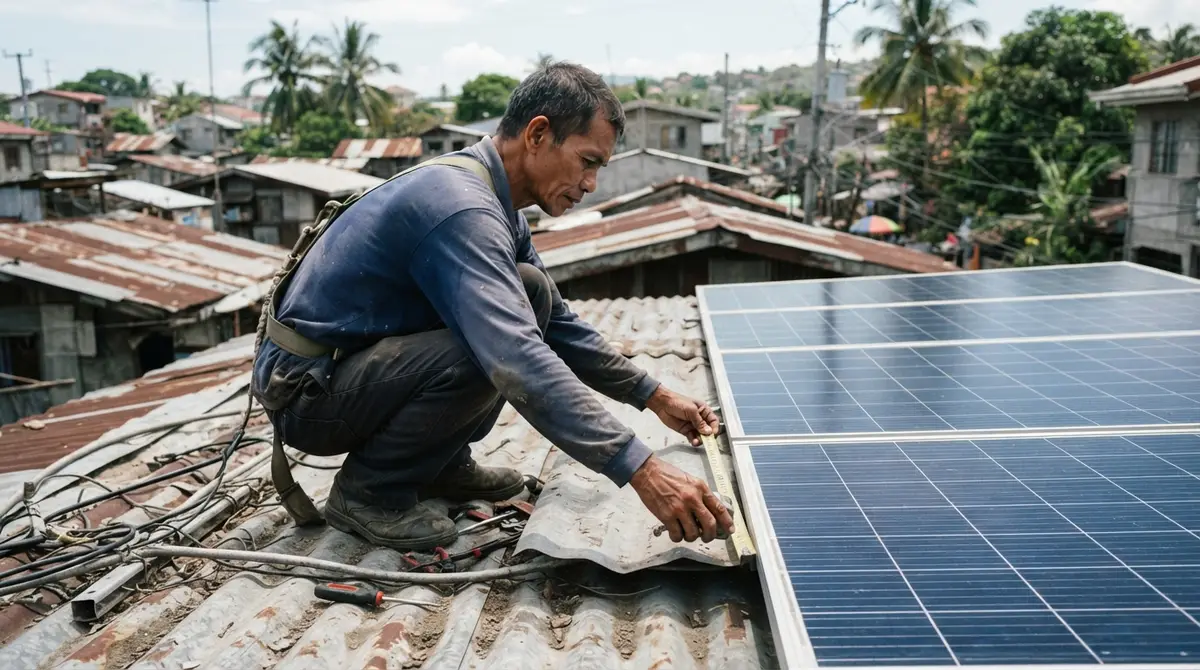
Weight and handling. A 600W module is a large, heavy object to carry up a ladder and position on a pitched roof. On older or more fragile roofing, the point loads at each mounting bracket matter — see roof types and mounting.
Wind loading. A larger panel is a larger sail. In typhoon-exposed areas the mounting system has to be specified for it, which is a good conversation to have explicitly rather than assume. Our typhoon backup guide touches on what survives and what does not.
Fit on complicated roofs. Philippine homes often have several small roof planes rather than one large one. Smaller panels genuinely tessellate better on a broken-up roof, and there are installs where 450W modules yield a larger total array than 600W ones simply because more of them fit.
How to use wattage when comparing quotes
Work in this order:
- Establish the kW you need from your bill — what size solar system for my bill.
- Compare quotes on installed price per kW, not on panel count or panel wattage.
- Check the panel count multiplies out to the array size quoted. Twelve 450W panels is 5.4kW, not 5kW, and the difference should be reflected in the price.
- Then look at brand, efficiency, and warranty to separate otherwise similar quotes — tier 1 vs tier 2 panels and warranties explained.
A quote advertising high-wattage panels at a poor price per kW is not a good deal. A quote using modest 450W panels at a strong price per kW, from a reputable brand with a serviceable warranty, usually is.
Frequently asked questions
Is a 600W panel better than a 450W panel?
Not inherently. A 600W panel is physically larger and produces more than a 450W one individually, but system output is set by total array size in kW, not by the wattage of each panel. Ten 450W panels and roughly eight 550W panels both give you about 4.5kW.
Does higher wattage mean higher efficiency?
Not necessarily. Efficiency is output per square metre, and much of the wattage increase over recent years came from making panels physically bigger. Compare the efficiency percentage if you want the real measure of how hard each square metre works.
What wattage panels are common in the Philippines in 2026?
Most new residential installs use panels somewhere in the 450-600W range, with 500-550W the commonest choice. Older stock at 350-400W still appears in cheaper quotes, which is worth noticing because it means more panels for the same array size.
Do fewer, bigger panels cost less to install?
Often slightly, since there are fewer modules to mount, wire, and handle. The saving is modest and can be offset if the larger panels themselves cost more per watt. Compare quotes on total installed price per kW rather than on panel count.
Does panel wattage change how many I need for my bill?
Only in count, not in capacity. Work out the kW you need from your bill first, then let wattage decide how many panels that becomes. Sizing should never start from the panel.
Are bigger panels harder to install on Philippine roofs?
Sometimes. Larger modules are heavier and more awkward on steep or fragile roofs, and they catch more wind, which matters in typhoon-exposed areas. On a tight or complicated roof, smaller panels can actually fit better.