12kW Solar System Philippines: Price, Panels, Output
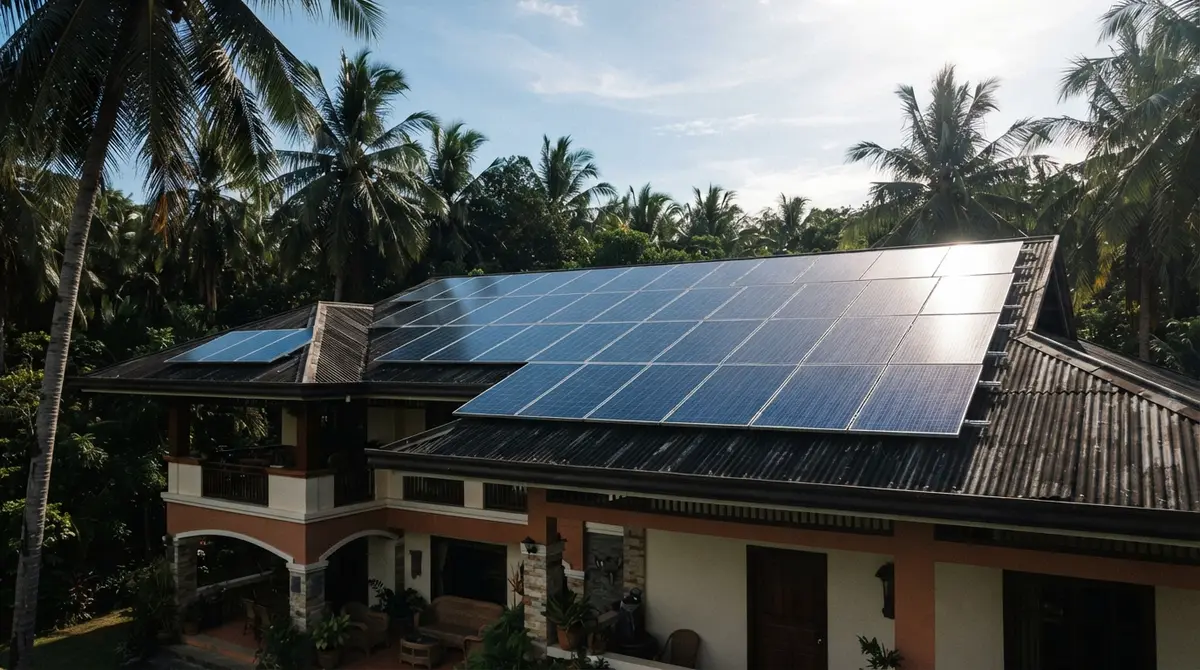
TL;DR
A 12kW grid-tied solar system suits a large home or home-plus-business with an ₱20,000-22,000/month bill. It needs about 22-24 panels and 84-108 sqm of roof, costs roughly ₱600,000-900,000 installed, produces about 1,440 kWh a month, and usually needs three-phase service.
A 12kW grid-tied solar system suits a large home or a home that doubles as a business, with an ₱20,000-22,000/month electric bill. It needs about 22-24 panels and 84-108 sqm of roof space, costs roughly ₱600,000-900,000 installed, and produces around 1,440 kWh a month.
What catches buyers out is not the price. 12kW is where Philippine equipment goes three-phase, and where the capacity of your street transformer stops being somebody else’s problem.
12kW system at a glance
| Metric | Estimate |
|---|---|
| Who it’s for | Large home or home-plus-business, ~₱20,000-22,000/month bill |
| Panel count | ~22-24 panels (500-550W each) |
| Roof space needed | ~84-108 sqm |
| Installed price | ~₱600,000-900,000 |
| Monthly output | ~1,440 kWh |
| Est. monthly savings | ~₱8,000-17,600 (40-80% of bill) |
| Inverter phase | Three-phase in practice |
| Payback period | ~4-7 years with daytime-heavy use |
10kW or 12kW?
The extra 2kW is the smallest part of the difference. Three things change at once:
| 10kW | 12kW | |
|---|---|---|
| Installed price | ₱500,000-750,000 | ₱600,000-900,000 |
| Monthly output | ~1,200 kWh | ~1,440 kWh |
| Roof space | 70-90 sqm | 84-108 sqm |
| Suits a bill of | ~₱15,000-17,000 | ~₱20,000-22,000 |
| Inverter | Single-phase or three-phase | Three-phase in practice |
| Transformer headroom | Fits most single-phase service drops | Needs a check before design |
A 10kW system can still be built on single-phase service with equipment stocked everywhere. At 12kW the inverter shortlist narrows to three-phase units, the array outgrows a lot of single-plane Philippine roofs, and the transformer feeding your street becomes a design input. None of that is a reason to avoid 12kW — it is a reason not to treat it as 10kW plus two panels.
Which 12kW inverters are actually sold in the Philippines?
Two, reliably, and both are three-phase hybrids:
| Inverter | Phase | Notes |
|---|---|---|
| Deye SUN-12K-SG04LP3-EU | Three-phase | 48V battery support, the most commonly quoted 12kW unit here. Around ₱85,000-105,000 for the inverter alone. |
| Solis S6-EH3P12K-H | Three-phase | 4 MPPTs, high-voltage battery, listed on Solis’s own Philippine product pages. |
Deye publishes the 12K in its SUN-5/6/8/10/12K-SG04LP3-EU three-phase series, and Solis lists the S6-EH3P12K-H on its Philippines site. Deye does build a single-phase 12kW hybrid for other markets, the SUN-12K-SG02LP1-EU, but Philippine price lists jump from single-phase 8kW straight to three-phase 12kW and 16kW. Assume three-phase unless your installer can show you local stock of the single-phase unit.
Growatt, the other brand most PH installers quote, is strongest here in the 3-6kW on-grid range. Our Deye vs Growatt comparison, Deye inverter review, and Solis inverter review go deeper, and the hybrid inverter price guide has current ranges by capacity.
Does your service need to be three-phase?
Most likely, and it is worth settling before you sign anything. A three-phase inverter needs a three-phase supply, and ordinary Philippine homes are single-phase. Two ways through it:
- Upgrade the service to three-phase. A separate application with your distribution utility, with its own cost and lead time. Get that quote before you commit to a 12kW design.
- Run two single-phase hybrids in parallel. Deye’s single-phase SG04LP1 hybrids support parallel operation, so 2 x 6kW reaches similar capacity on single-phase service. More hardware, more commissioning, more wiring — but no service upgrade.
Either way, the quote should say which it assumes. A 12kW quote silent on phase is incomplete.
Does 12kW run into a net metering or utility limit?
Not the net metering cap. Net metering under RA 9513 covers systems up to 100kW, so 12kW sits far inside it, and the application is the same one your installer files at any residential size — see how to apply for net metering and what net metering costs.
The limit that matters at 12kW is a different one. Meralco publishes a hosting capacity table on its solar and net-metering application page, capping how much solar can connect to each single-phase distribution transformer. A 37.5 kVA single-phase transformer is rated for 14 kW. That figure is, in Meralco’s words, “the aggregate maximum allowable capacity for solar PV systems per transformer level” — the total across every customer sharing that transformer, not your allowance alone.
So a 12kW array leaves about 2 kW of headroom on a 37.5 kVA transformer, and only if no neighbour on it has gone solar first. Smaller single-phase transformers carry lower allowances again. Meralco notes the table applies within its franchise area and that the final assessment depends on field conditions, so treat it as the question to ask rather than the answer: have your installer confirm your transformer size and the solar already on it before the design is finalised. If the distribution facilities need upgrading, Meralco runs a study and the cost lands on the project.
How many panels is 12kW, and how much roof does it need?
Work it from the panel you are actually being quoted. A Canadian Solar HiKu6 CS6W-550MS is a common Philippine module at 550W, measuring 2,278mm x 1,134mm, so 2.58 sqm each.
- 12,000W ÷ 550W = 21.8, so 22 panels
- 22 x 2.58 sqm = 57 sqm of module area
- At 500W panels: 24 panels. At 600W: 20 panels.
Module area is not roof area. Add walkways, edge setbacks, and clearance around vents and water tanks and you land at 84-108 sqm of usable, unshaded roof — the same 7-9 sqm per kW the 8kW and 10kW installs need, on a bigger array.
Two things follow that do not bite lower down the range. 84-108 sqm in one unshaded plane is more than most Philippine single-detached houses have, so 12kW arrays are routinely split across two roof faces or spill onto a carport or ground mount, and a split array needs an inverter with enough MPPT inputs — part of why four-MPPT units show up at this size. And 22 panels at 27.6 kg each is about 610 kg of modules before racking, so structural sign-off stops being a formality. See roof types and solar mounting.
What does a 12kW system cost installed?
Roughly ₱600,000-900,000, which is 12 x the ₱50,000-75,000 per kW this site uses at 8kW and 10kW. Installed cost per watt barely falls as systems grow here: labour and permits spread across more panels, but the inverter, wiring, and protection all step up in capacity, so the per-kW figure stays roughly flat from 6kW upward.
Advertised packages start well below that — Philippine installers list 12kW from around ₱420,000, grid-tied only at the bottom and battery-inclusive at the top. ₱420,000 is ₱35,000/kW, under what tier-1 panels plus a three-phase hybrid inverter plus permitting cost at any other size on this site. That does not make it a scam. It usually means no battery, budget modules, or a scope that excludes electrical works, so read the exclusions before comparing bottom-line figures — the price breakdown covers what belongs inside the number, and how to choose a solar installer covers what separates a good quote from a cheap one.
How fast does a 12kW system pay back?
4-7 years if most of the output is consumed as it is generated. A 12kW system producing ~1,440 kWh a month against an ₱20,000-22,000 bill saves roughly ₱8,000-17,600 a month, and where you land in that spread depends almost entirely on when the power gets used.
That spread is wider at 12kW than at 5kW, and the reason matters before you size up. Every kWh used as it is made displaces grid power at full retail. Every kWh exported earns roughly ₱5-7/kWh in net metering credit, less than half. A bigger array makes more surplus, so a house empty until 6pm exports a larger share of a larger number and can stretch past eight years, while a home business or a household running three aircon units through the afternoon lands at the fast end. See solar panels for aircon and the payback period guide.
If the property is genuinely commercial rather than a home with a business attached, financing and depreciation differ — see solar for small business. For the residential version worked from the appliance list up, see how many panels to run a whole house.
Where do I check current pricing or get numbers specific to my bill?
Run your actual monthly bill through the cost calculator for a size and price range matched to your usage rather than the general 12kW figures above, or work backwards from consumption with what size solar system for my bill. For current ranges across system sizes, see our price pages.
Frequently asked questions
How much does a 12kW solar system cost in the Philippines?
Roughly ₱600,000-900,000 installed, at the ₱50,000-75,000 per kW this site sees on 8kW and 10kW quotes. Advertised 12kW packages start lower, from around ₱420,000, but those are usually grid-tied only with no battery.
How many panels is a 12kW system?
About 22 panels at 550W, 24 at 500W, or 20 at 600W. At 550W a panel measures roughly 2,278mm x 1,134mm, so 22 of them cover about 57 sqm of module area and need 84-108 sqm of roof once walkways and edge setbacks are counted.
Do I need three-phase service for a 12kW solar system?
Usually yes. The 12kW hybrid inverters actually sold in the Philippines — the Deye SUN-12K-SG04LP3-EU and the Solis S6-EH3P12K-H — are three-phase units. Philippine single-phase hybrid lineups top out around 8kW, so a single-phase home either upgrades the service or runs two smaller inverters in parallel.
Does a 12kW system exceed the net metering limit?
No. Net metering under RA 9513 covers systems up to 100kW, so 12kW is well inside it. The limit that actually bites at this size is Meralco's hosting capacity table, which caps the total solar connected to each single-phase distribution transformer — a 37.5 kVA transformer is rated for 14 kW across every customer on it.
What bill size does a 12kW system suit?
Around ₱20,000-22,000 a month. At Meralco's mid-2026 all-in retail rate (roughly ₱14.83/kWh) that is roughly 1,350-1,480 kWh of consumption, which matches the system's output. Homes at this level are usually running three or more aircon units, or a business shares the meter.
How much power does a 12kW system produce?
About 1,440 kWh a month in typical Philippine conditions, roughly 48 kWh on an average day. Expect more through the dry season and meaningfully less during extended rainy stretches.
Should I get 10kW or 12kW?
Take 12kW only if the bill genuinely sits near ₱20,000 and most of that usage happens in daylight. The step from 10kW to 12kW adds a three-phase inverter, roughly 15 sqm more roof, and a transformer capacity question that 10kW mostly avoids, so it is a bigger jump than the extra 2kW suggests.