Agrivoltaics in the Philippines: Farming Under Solar Panels
TL;DR
Agrivoltaics means growing shade-tolerant crops or raising livestock on the same land as an elevated solar array, letting one plot generate power and food at once. It's proven overseas but still an emerging, mostly pilot-stage setup in the Philippines, not something a typical homeowner or farmer can order off the shelf yet.
Considering leasing land to a developer rather than building it yourself? See solar farms in the Philippines.
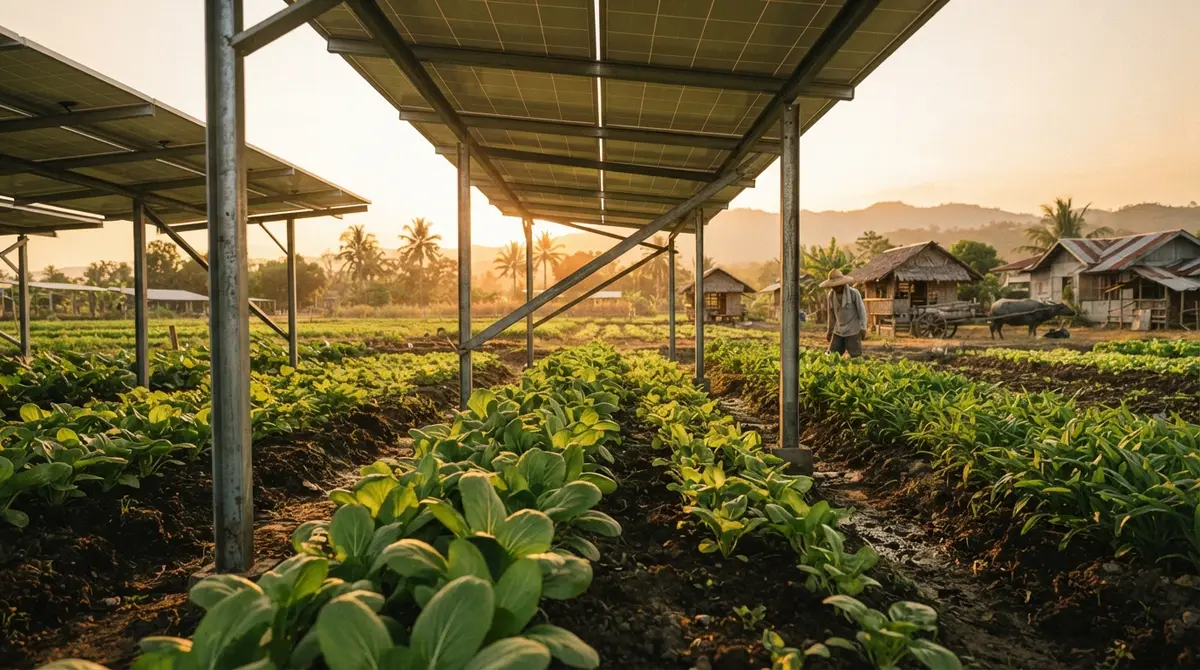
Agrivoltaics means putting solar panels and farming on the same land, with the array elevated and spaced so crops or livestock can still use the ground underneath. It’s a proven concept in some countries, but in the Philippines it’s still emerging: a few pilot and research projects, not a standard product an installer will quote you off a price list.
How does agrivoltaics actually work?
An agrivoltaic array elevates panels higher off the ground than a normal ground-mount system, often on taller posts, and spaces the rows wider apart. That extra height and spacing lets sunlight reach the crops between and under the panels, and lets farm equipment pass through. The panels still connect to an inverter and either feed the grid, a battery, or both, exactly like any other solar setup — what changes is the mounting structure and layout, not the electrical side.
What crops or livestock work under solar panels?
Shade-tolerant crops that don’t need full sun all day are the usual candidates overseas — leafy greens, root vegetables, and some herbs are commonly cited. Livestock grazing, particularly sheep, is another common pairing since animals benefit from the shade and the panels benefit from vegetation being kept low without machinery. None of this is locally validated at scale yet, so treat any specific crop recommendation as something to test on a small plot first, not a guarantee.
Why isn’t agrivoltaics more common in the Philippines yet?
A few practical reasons:
- Higher structural cost. Taller posts and wider spacing generally cost more per kW than a standard rooftop or dense ground-mount array.
- No established local playbook. Few installers here have built one before, so pricing and crop-yield data are thin.
- Land use and permitting questions. Combining agricultural and energy use on the same parcel can raise zoning and land-classification questions that a straightforward residential or commercial install doesn’t.
None of this rules it out — it just means it’s a project you plan with an agricultural engineer and installer together, not something you order like a rooftop system.
How does agrivoltaics compare to other rural solar setups?
| Setup | What it’s for | Maturity in PH |
|---|---|---|
| Rooftop residential | Home electricity | Mainstream |
| Ground-mount farm array | Power only, no crops underneath | Established |
| Off-grid provincial system | Power where there’s no grid connection | Established |
| Agrivoltaics | Power + farming, same land | Emerging/pilot |
If your actual goal is running farm equipment like a deep well water pump, a standard ground-mount or rooftop system solves that today without the added complexity of an agrivoltaic layout.
Is agrivoltaics worth pursuing now?
If you have open farmland and want to explore it, yes — as a research-backed pilot, not a turnkey purchase. Get an agricultural engineer involved alongside your solar installer before committing to layout or crop choice, since the wrong panel height or row spacing can hurt both the harvest and the energy yield. For a farm business weighing solar generally, our solar for small business guide covers the standard commercial-scale numbers agrivoltaics would need to beat to make sense.
What should you do next if you’re interested?
Start small. A single test row on a fraction of your land tells you more about local crop response than any overseas study will. Track yield under the panels against an unshaded control plot for at least one full growing season before scaling up, and loop in your installer on wiring and mounting only after the agronomic side checks out.
Frequently asked questions
What is agrivoltaics?
Agrivoltaics is farming under or between solar panels on the same piece of land, usually with panels mounted higher and spaced wider than a standard rooftop or ground-mount array so machinery and crops fit underneath.
Is agrivoltaics available in the Philippines?
It's emerging, not mainstream. A handful of pilot and research projects exist, but it isn't a standard commercial offering most installers quote the way they quote a rooftop or ground-mount system.
What crops work under solar panels?
Shade-tolerant crops that don't need full, uninterrupted sun tend to do best. Leafy greens, root crops, and certain herbs are commonly cited overseas; exact performance depends on the crop, panel height, and spacing, which is still being tested locally.
Does agrivoltaics reduce solar panel output?
The elevated, wider-spaced layout can mean fewer panels per hectare than a dense ground-mount array built purely for power. The tradeoff is that the same land also produces a crop, which a power-only array doesn't.
Can a homeowner do agrivoltaics?
Not in the typical rooftop sense. Agrivoltaics applies to farmland or open plots, not residential roofs. A homeowner with acreage would be looking at a ground-mount or elevated array, closer in scope to a small-business or farm project than a home solar order.
Who should look into agrivoltaics in the Philippines?
Landowners or agribusinesses with open farmland who want to explore dual land use should talk to an agricultural engineer and a solar installer together, since the structural, spacing, and crop questions go beyond a standard solar quote.