Solar Farms in the Philippines: How They Work and What Landowners Should Know
TL;DR
A solar farm is a ground-mounted array built to sell electricity into the grid, not to offset one building's bill. The dividing line in Philippine rules is 100kW: at or below it you are in net metering, above it you are a generator and need DOE registration, a different contract, and a route to market such as GEOP, a power supply agreement, or the spot market.
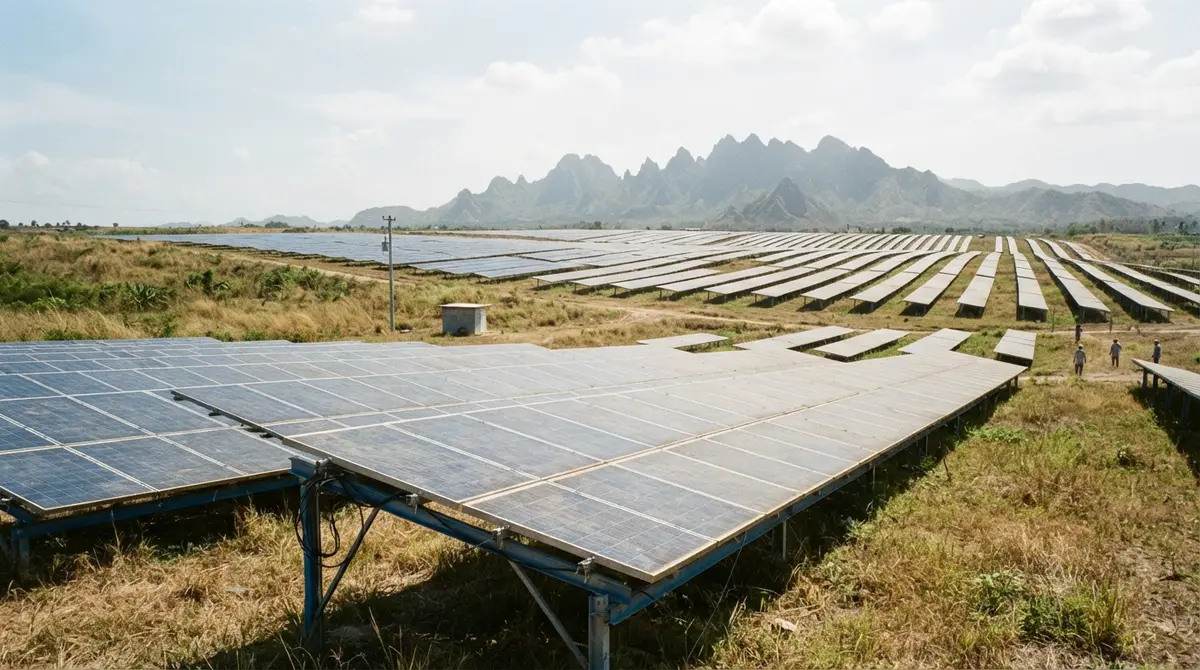
A solar farm is a ground-mounted array built to sell electricity into the grid, not to cut one building’s bill. That distinction is the whole subject. Everything else on this site is about offsetting your own consumption; a solar farm is a power project, with the registration, contracts and counterparties that implies.
If you landed here looking to cut a household bill, you want rooftop solar and net metering instead.
The 100kW line
Philippine rules draw a practical boundary at 100kW. Net metering under RA 9513 covers systems up to that size — you consume what you generate and export the surplus for a credit on your own bill. That is the regime almost every home and small business is in.
Above 100kW you are no longer offsetting consumption, you are generating for sale. That means a different contract with the utility, a grid impact study, and a route to market. It is a change in kind, not just in scale.
| Up to 100kW | Above 100kW | |
|---|---|---|
| Regime | Net metering | Generation for sale |
| What you do with output | Offset your own bill, export surplus | Sell to a buyer or the market |
| Surplus is worth | Generation-cost credit, roughly ₱5-7/kWh | Contracted or spot price |
| Who you deal with | Your distribution utility | DOE, ERC, utility, offtaker |
| Registration | Utility application | DOE renewable energy developer |
What a solar farm actually requires
- DOE registration as a renewable energy developer, with a service contract for the site.
- A route to market — a power supply agreement with a utility, a Green Energy Option customer, or the wholesale spot market. GEOP is aimed at large commercial and industrial end-users, not households.
- Grid connection, including impact studies and the physical interconnection, which for a project of this size is a substantial cost and timeline in itself.
- Land with the right characteristics — enough contiguous area, buildable ground, and crucially a viable connection point within reasonable distance.
The feed-in tariff was built for utility-scale renewables like these, which is precisely why it never applies to a rooftop system. If an installer offers you a “home FIT”, they are misinformed.
The incentives are developer incentives
RA 9513 offers VAT zero-rating, duty-free equipment imports and an income tax holiday. Those go to DOE-registered developers building power projects — not to a homeowner buying panels. This trips people up constantly, because the headline reads like a solar incentive when it is really an energy-project incentive.
If a developer approaches you about your land
The array is not the deal; the lease is. Before signing anything:
- Term and escalation. These leases run for decades. What does the rent do over that period?
- Land classification and taxes. Who carries the tax consequence if the land’s classification or assessed use changes?
- Financial close. What happens if the developer never actually builds? Is there a deadline after which the land is yours to use again?
- Decommissioning. Who removes the array at end of life, and who pays? Panels have a 25-year working life and then become something to dispose of.
- Can you still farm it? Agrivoltaics is emerging here, not standard. If dual use matters to you, it has to be written in.
Have a lawyer read the contract. This is not a solar decision, it is a long-term property decision that happens to involve solar.
What this page does not give you
Project economics. Land lease rates, capacity factors and offtake prices in the Philippines vary enormously by site, connection point and counterparty, and any single figure quoted here would be wrong for most projects. If you are seriously evaluating a site, that analysis comes from a developer or consultant with your actual location and grid data — not from a guide.
For anything at household scale, start with is solar worth it instead.
Frequently asked questions
What counts as a solar farm in the Philippines?
There is no single legal definition, but the practical line is 100kW. Net metering under RA 9513 covers systems up to 100kW, which is the regime rooftop and small commercial systems use. Above that you are generating for sale rather than offsetting your own consumption, and a different set of rules applies.
Can I put a solar farm on my land and sell the power?
Not without becoming a registered player. Selling electricity into the grid means DOE registration as a renewable energy developer, a service contract, grid connection approval, and a buyer — a utility, a GEOP customer, or the spot market. This is a project-development undertaking, not an equipment purchase.
Does the feed-in tariff still pay for new solar farms?
The FIT system was designed for utility-scale renewables under an installation-target and rate structure set by the ERC, and it does not apply to home rooftop solar at all. Whether a new project can still access it depends on the current DOE and ERC rules, which have moved over time — confirm before building a plan around it.
What incentives apply to a solar farm but not to my roof?
RA 9513 gives DOE-registered renewable energy developers VAT zero-rating, duty-free imports of equipment, and an income tax holiday. Those are developer incentives. A homeowner buying rooftop panels does not get them, which is a common source of confusion.
Should I lease my land to a solar developer?
It can be a long-term income stream, but the contract is the whole story: term length, escalation, who pays taxes on the reclassified land, decommissioning obligations, and what happens if the developer fails to reach financial close. Have a lawyer read it before you sign anything.
Can I farm the same land at the same time?
That is agrivoltaics, and it is technically proven overseas but still mostly pilot-stage in the Philippines. Do not assume a developer's array will be built high enough to farm under unless the lease says so explicitly.