Why Is My Solar Panel Not Working? (Philippines)
TL;DR
Most solar systems that stop producing have a simple cause: a tripped breaker, an inverter fault, new shade, or dirty panels. Work from the meter backwards before calling anyone. If the inverter shows an error code or there is any sign of burning or damaged wiring, stop and get a licensed electrician.
Most solar systems that stop producing have a simple, findable cause. Before assuming a panel has failed or an installer cheated you, work through the chain in order. The fault is usually closer to the inverter than to the roof.
One safety rule first: the DC side stays live whenever the sun is up. Flipping an AC breaker does not de-energise the panels or the DC cabling. Anything past checking a breaker and reading the display belongs to a licensed electrician.
Step 1: Is it actually a brownout?
A grid-tied system shuts down whenever the grid goes down, even at noon in full sun. That is deliberate and required — it prevents your array backfeeding a line that utility crews may be working on. The system restarts by itself once supply returns.
If your neighbours are also out, nothing is wrong with your solar. Our brownout guide explains the safety logic, and it is the reason a hybrid inverter and battery are what actually give you outage cover.
Step 2: What does the inverter say?
The inverter is the system’s diagnostic panel. Check it before anything else.
| What you see | Likely cause |
|---|---|
| No lights, blank display | AC breaker tripped, or no supply to the inverter |
| Green / normal, but low output | Shading, dirt, weather, or a dropped string |
| Error or fault code | Inverter has detected a problem and stopped on purpose |
| Red fault light | Same — note the exact code before doing anything |
Write down the exact error code and look it up in the manual or the manufacturer’s app, or in our Deye, Growatt and Solis error code tables. Codes are specific: grid voltage out of range, insulation fault, over-temperature. Reporting “it says E013” to your installer gets a far faster answer than “it is not working”.
Step 3: Check the breakers
There are usually at least two: an AC breaker in your consumer unit feeding the inverter, and a DC isolator near the inverter or the array.
Reset a tripped AC breaker once. If it trips again immediately, stop and call someone — a breaker that keeps tripping is doing its job about something real. Do not keep resetting it.
Leave the DC isolator alone unless your installer talks you through it.
Step 4: Look for new shade
Shade is the most common cause of output that has quietly declined over months. On a string system, one shaded panel can drag down the whole string, so a small obstruction has an outsized effect.
Walk the property at different times of day, not just at noon. Look for:
- A tree that has grown since installation
- A neighbour’s new second storey, water tank, or antenna
- A newly installed vent, aircon condenser, or roof accessory
Our shading guide covers why partial shade costs so much more than its area suggests.
Step 5: Are the panels dirty?
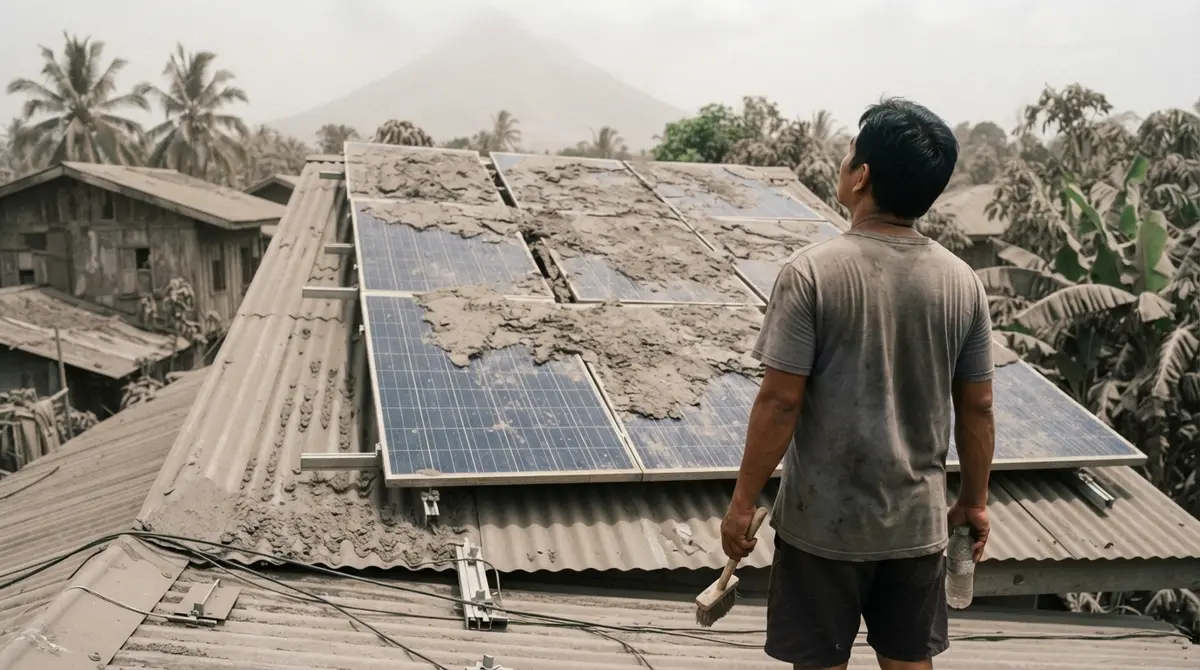
Dust, salt spray near the coast, bird droppings, and leaf debris all cut output. In Philippine conditions this builds up faster than people expect, and the rainy season does not clean panels as thoroughly as you would hope.
Cleaning is a reasonable homeowner job from the ground with a soft brush and water. Going on the roof is not, particularly on the sheet roofing common here. See how to clean solar panels.
Step 6: Compare against the right baseline
Before concluding anything is broken, check you are comparing fairly:
- Against the same month last year, not last month. Output legitimately falls through the rainy season.
- Against expected output, roughly 120 kWh per kW per month in Philippine conditions. A 5kW system averaging around 600 kWh a month is behaving normally.
- String against string. If your inverter reports per-string figures and two identical strings differ significantly, that points at a real fault.
Our monitoring guide covers what to record so this comparison is possible at all.
When to stop and call someone
Call a licensed electrician or your installer immediately, without touching anything, if you see:
- Any burning smell, scorch marks, or melted insulation
- Damaged or exposed DC cabling
- A breaker that trips repeatedly
- Water ingress at the inverter or any junction box
- Visible cracking, discolouration, or burn marks on a panel
The last one may be a warranty matter — photograph it before anyone touches it, and see solar panel warranties explained and how to claim a solar warranty.
Everything else is diagnosis, and the order above will usually find it.
Frequently asked questions
My solar is producing nothing at all. Where do I start?
Check the inverter display or app first. No lights at all usually means the AC breaker feeding it has tripped. An error code means the inverter has detected something and stopped deliberately. Both are quick to check before you assume the panels have failed.
Why is my solar producing less than it used to?
Gradual decline is usually dirt or new shading — a tree that grew, a neighbour's new structure, a water tank. Sudden partial decline often means one string or one panel has dropped out, which shows up in the inverter's per-string figures.
Does solar stop working during a brownout?
Yes, and that is correct behaviour. A grid-tied system shuts down when the grid goes down, even in full sun, so it cannot backfeed lines that utility crews may be working on. It restarts on its own once supply returns.
Can I fix solar problems myself?
Resetting a tripped breaker and cleaning panels are reasonable homeowner tasks. Anything involving DC wiring, opening the inverter, or working on the roof array is not. DC from a live array is dangerous and does not switch off because you flipped a breaker.
Why does my system produce less in the rainy season?
Because there is less light. Output falling through extended cloudy periods is normal, not a fault. Compare against the same month last year rather than against last month before concluding something is wrong.
How do I know if a panel has actually failed?
Individual panel failure is rare and usually shows as one string producing noticeably less than an identical one. Your installer can test string voltage and current. Visible damage, discolouration, or burn marks on a panel are grounds for a warranty claim.