Solar Cable Sizing in the Philippines: How It's Worked Out
TL;DR
Solar cable size is set by three things: the current it carries, the length of the run, and how much voltage drop is acceptable — normally kept under about 3%. Undersized cable runs hot, wastes output, and is a fire risk. Sizing must be done by a licensed electrical practitioner against the Philippine Electrical Code, not from an online table.
Solar cable size is set by three things: the current it carries, the length of the run, and how much voltage drop is acceptable. Get it wrong in the cheap direction and you lose output permanently and create a genuine fire risk.
This is one area where the honest advice is: do not do it yourself from a table online. Final sizing must come from a licensed professional electrical engineer working to the Philippine Electrical Code, and their signed drawings are required for your net metering application anyway. What follows is enough to understand your quote and ask sensible questions.
The three inputs
Current. More current needs more copper. On the DC side this comes from the array’s short-circuit current with the code-required safety margin applied. On the AC side it comes from the inverter’s maximum output.
Distance. Resistance accumulates over the run. A cable that is perfectly adequate over 5 metres may be badly undersized over 30. Long runs are common when the inverter sits far from the array, or in a carport install some distance from the house.
Acceptable voltage drop. Every metre loses a little voltage. Designers normally hold total drop under about 3%, because beyond that you are quietly throwing away generation you paid for.
Why voltage drop is the one to care about
Voltage drop is invisible. Nothing fails, no light comes on. Your system simply delivers less than it should, forever.
On a 5kW system producing around 600 kWh a month, an extra 2% of drop is roughly 12 kWh a month — about ₱170 at 2026 rates, every month, for 25 years. That is real money to save on slightly thinner cable, which is exactly why it gets cut.
Worth asking your installer directly: what is the calculated voltage drop on each run? A competent designer has the number. Reluctance to produce it is informative.
Derating: the part that catches people out
Cable ratings assume standard conditions. Philippine installs rarely match them. Capacity has to be derated for:
- High ambient temperature, especially in a roof space
- Direct sun exposure on the run
- Bundling — several cables together each shed heat less effectively
- Installation method — in conduit, in a tray, clipped to a surface
A cable rated adequately on paper can be marginal once these are applied. This is a major reason online calculators built for temperate climates give optimistic answers here.
DC cable is not ordinary wire
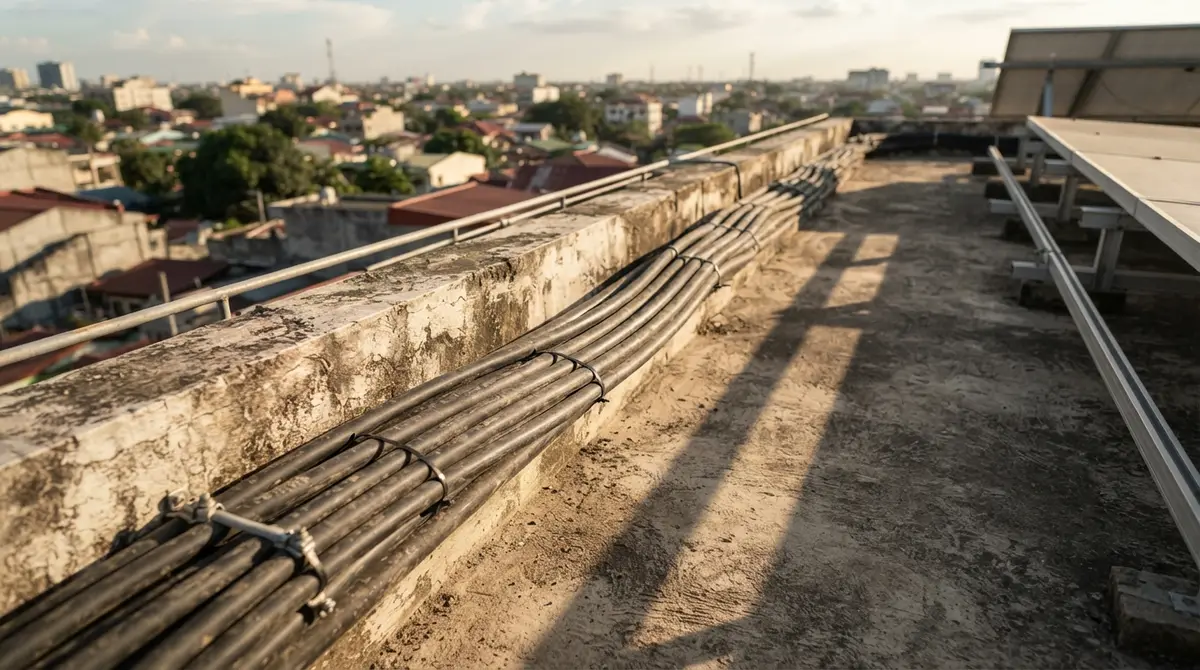
On the array side, cable is exposed to sun, heat, and rain continuously for decades. It needs to be rated for outdoor UV exposure and for the DC system voltage. Ordinary building wire will degrade, crack, and eventually expose conductor.
Connectors matter for the same reason. Poorly made or mismatched DC connectors are one of the more common causes of hot spots and faults in the field — our MC4 connector review and solar cable and connectors guide cover what to look for.
What to check in your quote
- Cable specification stated, not just “wiring included”. You want type, size, and rating written down.
- Calculated voltage drop for the DC and AC runs.
- UV-rated DC cable for anything exposed.
- Protection sized to match — see DC breaker sizing and surge protection.
- Signed drawings from a licensed PEE, which you need for net metering regardless.
If the quote says nothing about cable beyond a lump sum, ask. It is one of the easiest places to save money at your expense, and one of the few where the consequence is a fire rather than a disappointment. Our common installation mistakes guide covers the rest of what goes wrong, and how to choose a solar installer covers how to filter for people who get this right.
Frequently asked questions
What determines solar cable size?
Current, distance, and acceptable voltage drop. Higher current needs thicker cable; longer runs need thicker cable to keep voltage drop within limits. Ambient temperature and how the cable is installed also derate its capacity, which matters a lot in Philippine conditions.
What is voltage drop and why does it matter?
Every metre of cable loses a little voltage to resistance. Over a long thin run that loss becomes significant — it is generation you paid for and never receive. Designers normally keep total drop under about 3%.
Can I just use a cable size calculator online?
As a sanity check, not as a design. Online calculators rarely account for Philippine Electrical Code requirements, local derating for ambient temperature, or installation method. The final sizing needs a licensed professional electrical engineer, who also signs the drawings for net metering.
What happens if the cable is undersized?
It runs hot. That wastes energy, ages the insulation faster, and in the worst case starts a fire. It is one of the few solar shortcuts that is genuinely dangerous rather than merely disappointing.
Is DC cable different from AC cable?
Yes. DC cable on the array side must be rated for the voltage and for outdoor use — UV resistant, and suitable for continuous sun and heat. Ordinary building wire is not appropriate for exposed roof runs in this climate.
Does thicker cable improve my output?
Only up to the point where voltage drop stops being significant. Correctly sized cable delivers essentially all of it. Going thicker than required adds cost without adding output.