Solar Panel Theft in the Philippines: How to Secure Your Array
TL;DR
Philippine solar theft is documented at street-level and unattended installations, not at occupied homes. The exposed cases are ground mounts, carports, off-grid sites, and gear left on site before commissioning. Secure fixings, locked enclosures, monitoring alerts and serial records are the defence.
A solar array is a few hundred thousand pesos of portable hardware bolted to the outside of your house. That is the reason the question gets asked. The honest answer for the Philippines is narrower than the question implies: the theft that is actually documented here happens to equipment nobody is watching, at street level, on public and institutional installations. We could not find a reported case of panels being stripped off an occupied Philippine home.
That does not make prevention pointless. It changes what prevention is for. The exposed cases are ground mounts, carports, off-grid provincial systems, rest houses standing empty half the year, and the days between delivery and commissioning when the gear is on site and the system is not yet running.
Is solar panel theft actually a problem in the Philippines?
There is no published national figure, and we are not going to invent one. No Philippine agency publishes solar-specific theft statistics, insurers here do not publish claim frequencies by peril, and the industry associations have not issued anything on it. Anyone quoting you a Philippine solar theft rate is making it up.
What does exist is a consistent pattern in news and police reporting, all of it involving unattended equipment:
| Case | What was taken | Reported value |
|---|---|---|
| Santa Barbara, Iloilo, May 2026 | 129 solar streetlights along the national highway, owned by the DPWH; three suspects faced robbery charges | “P4.3 million, according to police estimates” |
| Barangay Nangka, Marikina, March 2026 | Solar lights from a jogging lane; two men caught dismantling a lamp post, one climbing, one bagging parts | About ₱9,450 in seized items, including a ₱5,000 panel-and-LED unit and ₱3,200 of battery packs |
| Bataraza and Rizal, southern Palawan, 2018 | Solar modules and deep-cycle batteries from seven public secondary schools | Not reported |
Read those three together and the pattern is about access, not about solar. Every target was outdoors, at ground or pole height, on property with nobody living on it. None was a house.
Copper is the adjacent risk and it is unambiguously organised here. Police arrested 17 people in Las Piñas in January 2026 over roughly ₱556,000 of telco copper cable, and five more in Parañaque in March over ₱210,000 worth. Those cases are telecommunications and utility cable, not solar DC cable, and we are not going to pretend otherwise. But solar DC runs are copper, and a run stapled along an exposed rail on a ground mount is the same material in a more reachable place.
Which installations are actually exposed?
The variable is reach, not value. A 600W panel is worth roughly the same wherever it is bolted; what differs is how long someone can stand next to it unobserved.
- Ground mounts. Panels at chest height, often near the property line. This is the single most exposed residential configuration, and our ground-mount and pole-mount guide is worth reading on siting before the frame goes in.
- Carports. Usually at the front of the lot, over open parking, sometimes with the array edge accessible from a vehicle roof. See the solar carport guide for how these get built.
- Off-grid and provincial systems. Remote sites, no permanent occupant, and a battery bank that is often the most valuable thing on the property. Off-grid systems carry 20-60kWh of storage, which is real money in a shed.
- Unfinished or unoccupied houses. A build site with panels already up and nobody sleeping there is the worst combination on this list.
- Street-level equipment. Inverters, combiner boxes and meters mounted on an outside wall facing the road.
- Standalone solar lights. The category with the most documented Philippine theft, precisely because each unit is small, unattached to a house, and complete in itself — see solar lights in the Philippines.
An array on the roof of a two-storey occupied house is at the other end of the scale. Removing a module means a ladder, tools, and time on someone’s roof while they are home.
What actually deters theft on a home system?
Almost all of it is decided at install time, and almost none of it can be retrofitted cheaply. Put it in the contract before work starts.
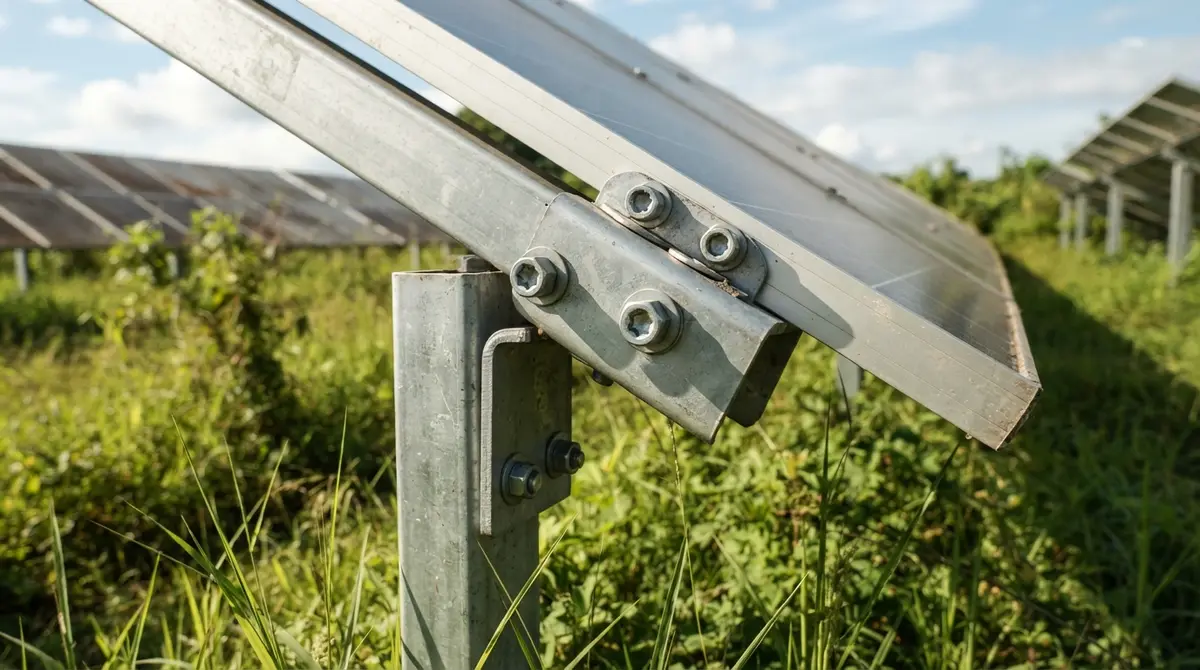
Fixings. Standard module clamps use ordinary bolts that any hex key undoes. Ask your installer to fit tamper-resistant fasteners on the clamps instead — security-head or one-way types that need a matching tool. They cost little on a residential array and turn a quiet job into a slow one. Ask for the tool and the spec sheet to be handed over at commissioning; you will need both for any future panel swap.
Mounting. Rails fixed through to structure rather than into roofing sheet resist being levered, and that is the same specification that keeps an array on the roof in a typhoon. The roof types and mounting guide covers what different Philippine roofs will hold.
Cable management. DC runs in conduit, clipped tight and terminated inside an enclosure, rather than draped along a rail. This is also the correct build for weather and rodents, so it is not a security-only cost.
Enclosures and placement. Inverter, combiner and battery belong inside a locked utility room or a lockable metal enclosure, not on an exterior wall facing the street. Batteries in particular are the highest value-per-kilogram item in the system — a 5kWh pack runs ₱65,000-115,000 installed — and they are the one component that is trivially portable once disconnected.
Sightlines and lighting. Clear the approach to a ground mount, light it, and point a camera at it. Nothing about this is solar-specific, and it is the cheapest item on the list.
Perimeter. For a ground mount, a fence that puts the array inside the property rather than at its edge does more than anything bolted to the panel.
Monitoring tells you, but only afterwards
Set up alerts, and understand what they are for. A removed module shows up as a string fault, a voltage change, or output that flatlines against a clear sky. Your inverter’s app will surface that, which means you find out in hours rather than at the end of the month.
It is detection, not prevention. Most residential monitoring reports at intervals rather than continuously, and an alert is only useful if someone reads it. Our guides on what to track and monitoring apps in the Philippines cover getting alerts configured and confirming you actually have login access tied to your inverter’s serial number.
The records that decide whether you get anything back
This is the part people skip, and it is the part that matters after the fact. Build the file at commissioning, while everything is in front of you.
- Every serial number. Panels, inverter, battery, optimizers. Photograph the labels before the panels go up, because after installation they face the roof.
- The invoice and the itemised quote, with brands and models named.
- Photographs of the finished install, wide and close.
- Commissioning documents and warranty certificates, which already carry the serials. Our warranty claim guide asks for the same file for a completely different reason, so you are building it once.
- A property mark on the frame or backsheet, applied where it does not cover a label or void anything. It is a small deterrent and a real aid to identification.
One honest limit: the Philippines has no registry where you can record solar equipment serial numbers, and no equivalent of a stolen-phone database for panels or inverters. The record is only useful because you hold it and can hand it to police and your insurer. That is a reason to keep it carefully, not a reason to skip it.
The riskiest window is before the system is switched on
Delivered equipment sitting on an unfinished site is the most exposed the hardware will ever be. It is outdoors, boxed, unbolted, uninsured under your homeowner’s policy, and often unguarded overnight.
Two things fix most of it. Schedule delivery for the day installation starts rather than a week ahead, and settle in writing whose insurance covers the equipment while it is on site and before handover. That is a fair question to put to any contractor, and the answer tells you something either way — see how to choose a solar installer.
What to do after a theft
1. Treat it as electrically live. A partly stripped array can leave energised DC conductors and cut ends exposed. Nobody should touch it, tidy it, or climb up to look. Isolate at the DC breaker only if it is safe and accessible, and call your installer or a licensed electrician first.
2. Photograph everything before you clean up. Damage, cut cable ends, missing modules, and the surrounding area. Your insurer and the police will both want it, and it cannot be recreated once the site is tidied.
3. File a police blotter entry. Report at the PNP station with jurisdiction over where the theft happened, and ask for a certified copy of the entry once it is recorded. The blotter is the foundational record for both the criminal case and an insurance claim, and insurers commonly want it filed quickly. Exact requirements and timelines vary by station and by insurer, so confirm both rather than assuming.
4. Bring the serial numbers. Give police the list from your commissioning file, along with the invoice and the install photographs. Without serials, recovered equipment cannot be tied back to you.
5. Notify your insurer promptly, and your installer. The installer needs to know because your monitoring account, warranty registrations and service history are all keyed to those serials.
6. Do not replace panels piecemeal without asking. Dropping a different module into an existing string can affect how the whole string performs. Let the installer specify the replacement.
Does insurance cover stolen solar equipment?
Theft is a standard insured peril, but coverage turns on whether the installation was ever declared. Rooftop solar is normally treated as a permanent improvement to the building, which means it may fall inside an existing homeowner’s policy only if you told your insurer it exists and raised the sum insured to match. An undeclared array is the common reason a claim disappoints.
The full picture — what to confirm in writing, how batteries are treated, and why a manufacturer warranty covers none of this — is in our solar panel insurance guide. That is the page to read before you need it.
Buying secondhand carries its own legal risk
If you are shopping for cheap used panels, the exposure runs the other way. Under the Anti-Fencing Law (Presidential Decree No. 1612), mere possession of an article that has been the subject of robbery or theft is prima facie evidence of fencing, and it falls to the possessor to show lawful acquisition. In practice that means keeping a receipt, the seller’s identity, and any documentation of where the equipment originally came from.
When the Palawan school systems were taken, buyers were publicly warned to make sure they were not unknowingly purchasing stolen units. That advice has not changed. Our guides on where to buy solar panels and avoiding solar scams cover what a legitimate supply chain looks like.
A short checklist
- Specify tamper-resistant clamp fasteners in the contract, and get the tool at handover
- Keep the inverter and battery in a locked room or enclosure, away from the street
- Run DC cable in conduit, not loose along a rail
- Fence, light and clear the approach to any ground mount
- Turn on monitoring alerts and confirm you can log in
- Photograph every serial number before the panels go up
- Schedule equipment delivery for the day work starts, not earlier
- Declare the installed value to your insurer once commissioned
Nearly all of that is either free or a rounding error against the installed cost of the system, and nearly all of it is easier to arrange at install time than at any point afterwards.
Frequently asked questions
Is solar panel theft common in the Philippines?
There is no published Philippine theft rate for solar equipment, so nobody can honestly call it common or rare. What is documented is theft from street-level and unattended installations — solar streetlights in Iloilo and Marikina, school arrays in Palawan. We found no reported case of panels taken from an occupied home's roof.
Which solar installations are most at risk?
Anything reachable from outside the property line and not watched. Ground mounts near a fence, carport arrays over open parking, pole-mounted panels, off-grid systems at unoccupied farm or rest houses, and equipment sitting on site before the system is commissioned.
How do you physically secure solar panels?
Ask the installer for tamper-resistant clamp fasteners rather than standard bolts, rails through-fixed to structure, DC cabling run in conduit instead of loose along a rail, and a locked enclosure or indoor location for the inverter and battery. Specify it in the contract before the install, not after.
Does home insurance cover stolen solar panels?
Theft is a standard insured peril, but only if the array is declared to your insurer and the sum insured was raised to match. An undeclared installation is the usual reason a claim fails. Our solar insurance guide covers what to confirm in writing.
Will my monitoring app tell me if a panel is stolen?
It will show the loss as a string fault or a drop in output, but after the fact, and only if you have alerts switched on and someone reads them. Most residential apps report at intervals rather than instantly, so treat monitoring as detection, not prevention.
What should I do if my solar equipment is stolen?
Treat the array as electrically live and call your installer or a licensed electrician before anyone goes near it. File a police blotter entry at the station with jurisdiction and ask for a certified copy, notify your insurer promptly, and give police the serial numbers from your commissioning documents.
Is it risky to buy secondhand solar panels?
Legally, yes, if you cannot show where they came from. Under the Anti-Fencing Law (PD 1612), mere possession of an item that turns out to have been stolen is prima facie evidence of fencing, and it falls to the possessor to explain lawful acquisition. Keep receipts and seller details.